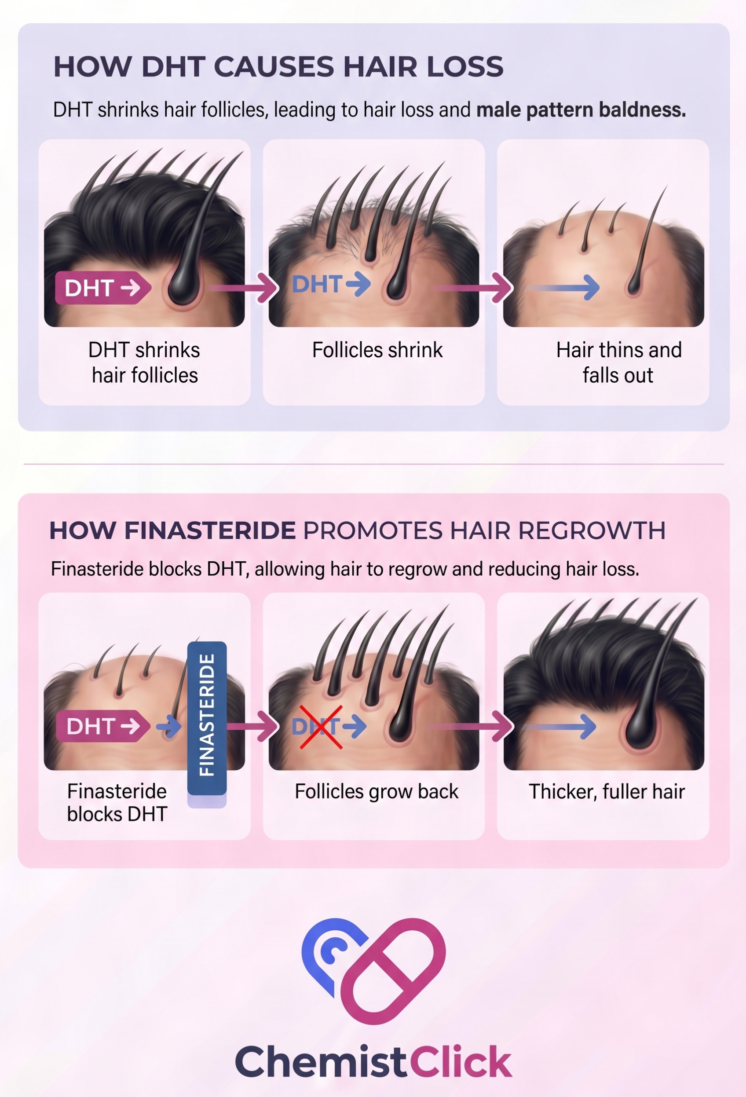
Yes. Finasteride works for many men with male pattern hair loss, also known as androgenetic alopecia. It is a prescription medicine that helps reduce the effect of DHT, the hormone strongly linked to genetic hair loss in men.
Finasteride is best understood as a treatment that helps slow, stop or stabilise hair loss. Some men also notice visible regrowth or thicker-looking hair, but regrowth is not guaranteed.
For many men, a good response to finasteride means:
Finasteride is not a cure for male pattern baldness. It only works while it is being taken. If treatment is stopped, DHT levels gradually rise again and hair loss is likely to continue.
Finasteride works by blocking an enzyme called 5-alpha reductase. This enzyme converts testosterone into dihydrotestosterone, also known as DHT.
DHT is the hormone strongly linked to male pattern hair loss. In men who are genetically sensitive to DHT, it binds to hair follicles and causes them to gradually shrink. This process is called follicle miniaturisation.
As follicles miniaturise, they produce hairs that are:
Over time, affected follicles may stop producing visible hair.
By lowering DHT levels, finasteride helps reduce further follicle miniaturisation. This can help protect existing hair, slow further loss and, in some men, allow miniaturised hairs to become thicker over time.
Finasteride is also used at a higher dose to treat benign prostatic hyperplasia, or BPH. In BPH, DHT contributes to prostate enlargement. Lowering DHT can help shrink the prostate and improve urinary symptoms.
Finasteride lowers DHT by blocking 5-alpha reductase. DHT is the hormone that drives follicle miniaturisation in male pattern hair loss.
Lowering DHT does not create instant new hair. Instead, it helps reduce the hormonal pressure on sensitive hair follicles. This can slow hair loss and give affected follicles a better chance of maintaining thicker, stronger hair.
This is why finasteride is often described as a maintenance treatment. It helps protect the hair you still have, and some men may also see regrowth.
Finasteride is considered an effective treatment for male pattern hair loss when taken consistently.
Clinical studies show that finasteride can stop further hair loss in around 80-90% of men, while many men also see visible regrowth or improved hair thickness over time.
However, expectations should be realistic. Finasteride is usually better at maintaining existing hair than restoring areas that have been completely bald for a long time.
Finasteride is more likely to work well if:
No. Finasteride is not a cure for male pattern hair loss. It is a long-term treatment that works while it is being taken.
If you stop taking finasteride, DHT levels gradually return to their previous level. Over time, hair loss is likely to continue, and hair maintained by treatment may be lost.
Finasteride is more likely to help men who:
Finasteride is less likely to restore hair in areas that are already completely bald.
Finasteride is not suitable for everyone. You should speak to a prescriber before using finasteride if you:
Finasteride 1mg for hair loss is prescribed for men. It is not suitable for women who are pregnant or may become pregnant because it can harm a developing male baby.
Further reading: Finasteride side effects
Important MHRA safety warning
The MHRA has issued warnings about finasteride and the risk of sexual side effects, mood changes, depression and suicidal thoughts. Some sexual side effects have been reported to continue after stopping treatment.

Patients taking finasteride 1mg for hair loss should stop treatment and seek medical advice if they develop depression or suicidal thoughts.
Patients should also speak to a healthcare professional if they experience sexual side effects such as reduced libido, erectile dysfunction or ejaculation changes.
For more information, read the MHRA safety update on finasteride.
Finasteride does work for many men with male pattern hair loss, especially when treatment is started early and taken consistently.
Its main benefit is helping to slow, stop or stabilise further hair loss by lowering DHT. Some men also see improved hair thickness or visible regrowth, but this varies from person to person.
Finasteride is a long-term treatment, not a permanent cure. It also carries important safety considerations, including MHRA warnings about sexual side effects and mood changes. A clinical assessment is important before starting treatment to make sure it is suitable.
Yes. Finasteride works for many men with male pattern hair loss by lowering DHT, the hormone that contributes to shrinking hair follicles. It is most effective at slowing or stopping further hair loss.
Finasteride can regrow hair in some men, but regrowth is not guaranteed. It is more likely to improve thinning areas where follicles are still active.
Finasteride is generally better at stopping or slowing hair loss than regrowing hair. Some men do see regrowth, but the main aim is to preserve existing hair.
No. Finasteride does not work for everyone. It is more likely to work when hair loss is mild to moderate and treatment is started before follicles become inactive.
Yes, finasteride often works well on crown thinning. It may help reduce further thinning and improve the appearance of scalp coverage in some men.
Finasteride may help slow a receding hairline, but hairline results are less predictable than crown results. It usually works best when started early.
No. Finasteride only works while you continue taking it. If you stop treatment, DHT levels rise again and hair loss is likely to continue.
Finasteride may be suitable if you have male pattern hair loss and want to slow or stabilise further thinning. A prescriber should assess your medical history, symptoms, suitability and risk of side effects before treatment is supplied.
Yes, most men keep the hair they have while taking finasteride.
Yes, finasteride can thicken thinning hair, especially on the crown and mid-scalp.
About finasteride (2023) [accessed 20th May 2026] https://www.nhs.uk/medicines/finasteride/about-finasteride/
Long-term (10-year) efficacy of finasteride in 523 Japanese men with androgenetic alopecia (2019) [accessed 20th May 2026] https://www.oatext.com/Long-term-%2810-year%29-efficacy-of-finasteride-in-523-Japanese-men-with-androgenetic-alopecia.php
Adverse Effects and Safety of 5-alpha Reductase Inhibitors (Finasteride, Dutasteride): A Systematic Review (2016) [accessed 20th May 2026] https://pmc.ncbi.nlm.nih.gov/articles/PMC5023004/
Whilst all of our content is written and reviewed by healthcare professionals, it is not intended to be substituted for or used as medical advice. If you have any questions or concerns about your health, please speak to your doctor.