Mechanism of Action: Unlike Wegovy (semaglutide), which only targets GLP-1 receptors, Zenagamtide activates both GLP-1 and amylin receptors. This dual action is thought to be more effective.
Administration: It is being developed in two forms: a daily oral tablet and a subcutaneous injection.
Clinical Results: Phase 1 and 2 trials indicated strong weight loss, with some studies showing roughly 13.1% weight loss with the oral tablet, and 24.3% weight loss with the injection after 3 months.
Safety and Side Effects: Early data indicates the drug is safe and tolerable, with side effects similar to existing GLP-1 treatments, such as nausea, diarrhoea, and constipation.
Availability: As of late 2025, it is still in clinical trials and not yet available for prescription, with late-stage trials expected in 2026.
Zenagamtide, formerly known as Amycretin, is an experimental weight loss medicine being developed by Novo Nordisk, the company behind Wegovy and Ozempic.
It is being studied as both a GLP tablet and a weekly injection for weight management and type 2 diabetes.
Novo Nordisk’s 2025 annual report describes Zenagamtide as a pipeline medicine that is expected to start phase 3 trials in 2026, which means it is not yet approved or available to buy.
There has been excitement around Zenagamtide because early trial data suggests it may produce significant weight loss.
However, it is important to be clear: Zenagamtide is still in clinical trials. It is not currently licensed in the UK, US or Europe, and there is no confirmed launch date. Any suggestion that it could reach the market next year remains speculative and would depend on successful phase 3 results and regulatory approval.
How does Zenagamtide work?
Zenagamtide is a dual-action medicine. It acts on both the GLP-1 receptor and the amylin receptor. These are hormone pathways involved in appetite, fullness, food intake and blood sugar regulation.
GLP-1 medicines, such as Wegovy, help reduce appetite, slow stomach emptying and make you feel fuller after eating. Amylin is another hormone that helps signal fullness and reduce food intake.
By combining both actions in one medicine, Zenagamtide is designed to help people feel satisfied with smaller portions and reduce overall calorie intake.
In simple terms, Zenagamtide is not a “fat burner”. It helps weight loss mainly by reducing hunger and helping people eat less.
How to take Zenagamtide
Zenagamtide is not approved yet, so there are no official patient instructions, licensed doses or prescribing rules.
In clinical trials, it has been studied in two forms:
Form
How often it is being studied
Zenagamtide tablet
Once daily
Zenagamtide injection
Once weekly
The tablet version is likely to attract the most patient interest because it could offer a non-injectable alternative to weight loss injections.
However, we do not yet know the final dose, whether it will need to be taken with or without food, what the missed-dose advice will be, or how long patients will be advised to stay on it.
Zenagamtide results: How much weight can you lose?
Early results are promising, but they are not final. Zenagamtide has not yet completed the large phase 3 trials needed to confirm its effectiveness in a wider population.
Zenagamtide tablets
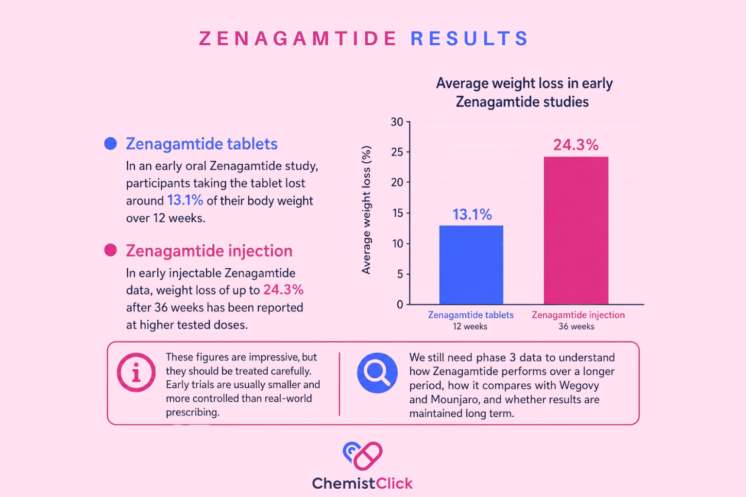
In an early oral Zenagamtide study, participants taking the tablet lost around 13.1% of their body weight over 12 weeks.
Zenagamtide injection
In early injectable Zenagamtide data, weight loss of up to 24.3% after 36 weeks has been reported at higher tested doses.
These figures are impressive, but they should be treated carefully. Early trials are usually smaller and more controlled than real-world prescribing.
We still need phase 3 data to understand how Zenagamtide performs over a longer period, how it compares with Wegovy and Mounjaro, and whether results are maintained long term.
Zenagamtide results
Zenagamtide dosage
Zenagamtide is still in clinical trials, so there is no approved patient dose yet. The doses below are research doses only and may not reflect the final licensed dosing schedule.
Oral Zenagamtide tablets dosage
Oral Zenagamtide has been studied as a once-daily tablet. Early trials tested single doses from 1mg to 25mg, followed by dose-escalation schedules up to 50mg once daily and, in some groups, up to 100mg once daily using two tablets.
Injectable Zenagamtide dosage
Injectable Zenagamtide has been studied as a once-weekly injection. In obesity trials, doses were escalated up to 20mg and 60mg once weekly, with the highest weekly dose linked to the largest reported weight loss in early studies.
Important note
These are clinical trial doses, not prescribing instructions. If Zenagamtide is approved, the final dose, starting schedule and dose increases will be confirmed in the official product information.
Zenagamtide side effects
The most commonly reported side effects so far appear to be similar to other GLP-1-based weight loss treatments. These are mainly digestive side effects, such as:
Common possible side effects
What this may feel like
Nausea
Feeling sick, especially when starting or increasing dose
Vomiting
Being sick
Diarrhoea
Loose or frequent stools
Constipation
Difficulty opening bowels
Reduced appetite
Feeling full quickly
Indigestion or reflux
Heartburn, burping or stomach discomfort
Published Lancet trial summaries describe Zenagamtide as having a safety and tolerability profile broadly similar to other GLP-1 and amylin-based medicines, with gastrointestinal side effects being the main issue.
However, the full side-effect profile is not yet known. Larger and longer studies are needed to identify uncommon side effects and long-term risks.
Is Zenagamtide safe?
So far, early studies suggest Zenagamtide is generally tolerable in clinical trial settings, but it is too early to say it is safe for routine use. It has not yet been approved by regulators such as the MHRA, FDA or EMA.
This matters because Zenagamtide is a new medicine. We do not yet have years of real-world prescribing data, and we do not yet know its full long-term safety profile. If it is approved in future, regulators will publish detailed safety information, including who can take it, who should avoid it, and what monitoring may be needed.
Can you just stop taking Zenagamtide?
There is no official stopping guidance yet because Zenagamtide is not approved.
Based on how similar appetite-based weight loss medicines work, stopping Zenagamtide would likely mean the appetite-suppressing effect gradually wears off. Hunger may return, cravings may increase, and weight regain may happen if there is no long-term plan around food, activity and behavioural support.
If Zenagamtide becomes available in future, patients should only stop or restart it under the guidance of a qualified prescriber.
Where can I buy Zenagamtide from?
You cannot currently buy Zenagamtide legally as a licensed weight loss treatment.
It is still in clinical trials and has not been approved for routine prescribing. Any website, social media seller or overseas supplier claiming to sell Zenagamtide now should be treated with extreme caution. These products may be counterfeit, unlicensed, incorrectly dosed or unsafe.
At present, the only legitimate way to access Zenagamtide would be through an approved clinical trial.
Bottom line
Zenagamtide, formerly Amycretin, is one of Novo Nordisk’s most interesting next-generation weight loss medicines. It targets both GLP-1 and amylin pathways and is being studied as a tablet and an injection.
Early results are promising, especially for weight loss, but Zenagamtide is still investigational. It is not licensed in the UK, it is not available to buy, and its long-term safety and effectiveness still need to be confirmed in larger phase 3 trials. Patients should avoid any supplier claiming to sell Zenagamtide and should only use licensed weight loss treatments prescribed by regulated healthcare professionals.
Frequently Asked Questions
Possibly in the future, but not yet. Zenagamtide would first need to complete clinical trials, gain regulatory approval, and then be reviewed for cost-effectiveness before NHS access could be considered. There is currently no confirmed NHS launch date.
There is no approved monthly weight loss figure yet. In early oral trial data, participants lost around 10.4% to 13.1% over 12 weeks, but this was in a controlled study and should not be treated as a guaranteed real-world result.
No. Zenagamtide is not a fat burner. It works by targeting appetite and fullness pathways, helping people eat less. Fat loss may happen when reduced appetite leads to a sustained calorie deficit.
There is no final public prescribing information yet, so we do not have an approved answer for how long Zenagamtide stays in the body. This will depend on the final formulation, dose and half-life data confirmed during clinical development.
There is no official alcohol guidance yet. If Zenagamtide behaves like similar weight loss medicines, alcohol may worsen nausea, reflux or vomiting in some people. Alcohol can also make weight loss harder because it adds calories and may increase snacking or poor food choices.
Tiredness has not been established as a main side effect in the way digestive symptoms have. However, some people taking appetite-suppressing medicines may feel tired if they are eating too little, dehydrated or experiencing nausea. More data is needed.
No price has been confirmed. Zenagamtide is not approved or commercially available, so any pricing estimate would be speculative. If it launches privately before wider health service access, the cost will depend on manufacturer pricing, dose, formulation and supply route.
Whilst all of our content is written and reviewed by healthcare professionals, it is not intended to be substituted for or used as medical advice. If you have any questions or concerns about your health, please speak to your doctor.