Starting Mounjaro (tirzepatide) can feel confusing, especially when it comes to understanding how the dose changes over time.

Unlike many medicines that stay at one fixed dose, Mounjaro is introduced gradually, with the dose usually increased every four weeks to help your body adjust and reduce side effects.

This guide explains the standard Mounjaro dosing schedule, from the starting dose to higher maintenance doses. It covers when dose increases may be recommended, why some people stay on a lower dose for longer, and whether increasing your dose is always necessary.

This information is a general guide only. Your exact dose and any dose changes should always be decided with your doctor or pharmacist.

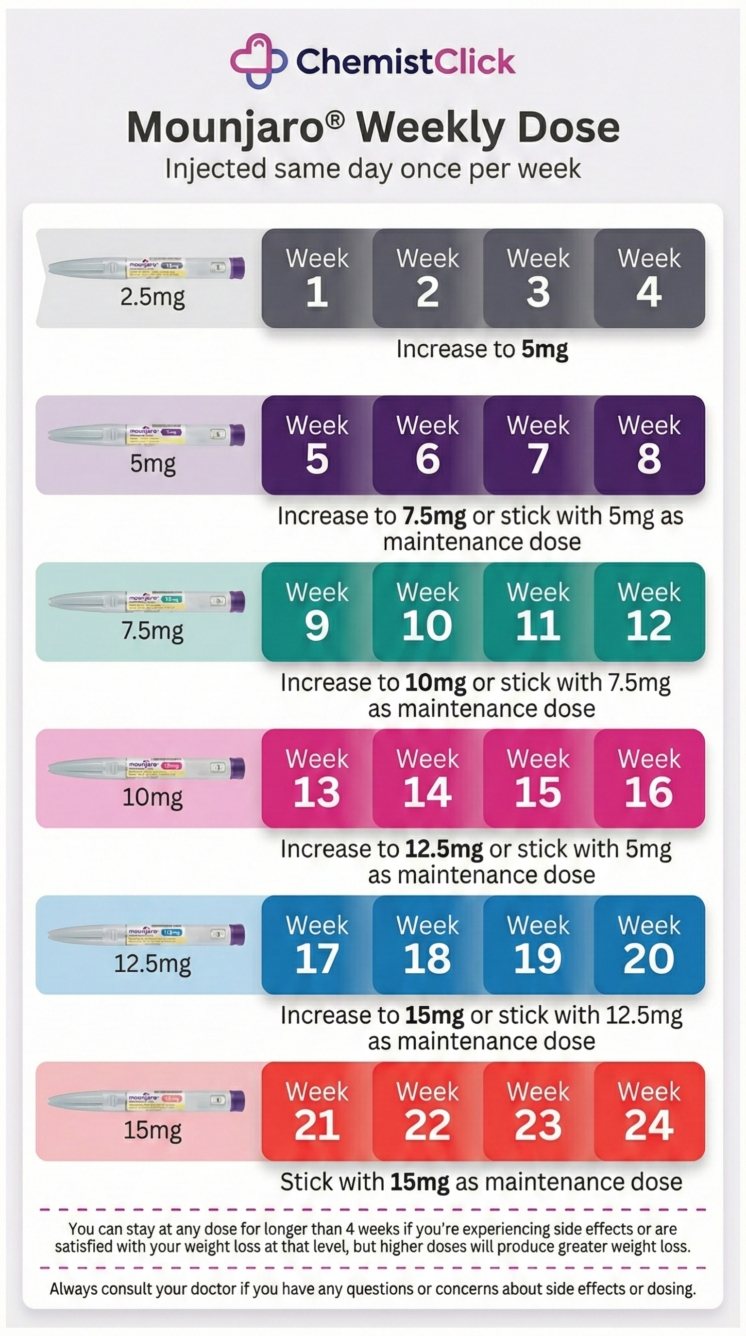
Mounjaro dosage chart

Our Mounjaro dosage chart explains when you need to increase your dose.

This is a general guide and responses to treatment may vary.

Mounjaro requires an individualised treatment plan for each patient.

Always consult with your doctor or pharmacist beforehand.

Mounjaro Dosage Chart

Mounjaro doses: What you should know

The key to getting the best Mounjaro results while minimising side effects is following a carefully structured dosing plan.

Here’s a simple breakdown of the available doses and what each is for:

2.5mg (starting dose)

This is the introductory dose used for the first 4 weeks. Its main purpose is to help your body adjust and reduce side effects such as nausea or digestive upset. It is considered a sub-therapeutic dose, meaning it is not intended to produce meaningful weight loss.

Average weight loss: 2-4%

5mg (first step-up dose)

Usually started after 4 weeks. This is the first dose that begins to provide noticeable appetite suppression and weight-loss benefits, while still being gentle enough for most people to tolerate.

Average weight loss: 4-7%

7.5mg (lower maintenance dose)

A lower long-term dose for people who respond well and want steady, moderate results. Some people remain at this dose if they are losing weight comfortably and tolerating treatment well.

Average weight loss: 7-10%

10mg (intermediate maintenance dose)

A common long-term dose that offers stronger appetite control and more significant weight loss, while keeping side effects manageable for most people.

Average weight loss: 9-13%

12.5 mg (higher maintenance dose)

For people aiming for greater weight loss who tolerate lower doses well. Side effects may increase slightly at this level, so careful monitoring is important.

Average weight loss: 11-16%

15mg (highest maintenance dose)

The maximum dose of Mounjaro, associated with the greatest average weight loss. It is typically reserved for people who need stronger results and can tolerate higher doses.

Average weight loss: 13-18%

Important:
*The average weight loss if Mounjaro is continued for 72 weeks is likely to be:

  • 5mg: 16% of starting weight
  • 10mg: 21.4% of starting weight
  • 15mg: 22.5% of starting weight

You do not have to increase your dose every 4 weeks. Many people stay at a lower dose for longer if they are getting good results or experiencing side effects. Dose changes should always be guided by your doctor or pharmacist.

Mounjaro

Start your weight loss journey with Mounjaro

Check Eligibility
Rated Excellent
Trustpilot Icon

When to increase your Mounjaro dose

Mounjaro is started at a low dose and increased gradually to help your body adjust and reduce side effects.

The Mounjaro dose is usually increased every 4 weeks until you find the right balance between appetite control and side effects.

If you are tolerating your current dose well and not experiencing significant side effects, moving up a dose can help improve appetite suppression and maximise weight-loss benefits.

However, higher doses also increase the chance of side effects such as nausea or digestive upset.

For this reason, you should only increase your dose if you are feeling well on your current one. If side effects become troublesome after a dose increase, you can reduce back to the previous dose.

You may be ready to increase your dose if:

  • You have been on your current dose for at least 4 weeks
  • Side effects such as nausea or stomach upset are mild or have settled
  • Your appetite suppression has started to wear off
  • Your weight loss has slowed or plateaued
  • You feel comfortable with how your body is responding

You may want to stay on your current dose for longer if:

  • You are still losing weight steadily
  • You are getting good appetite control
  • You are experiencing side effects that have not fully settled
  • You feel well and are happy with your progress

Key points

  • You do not have to increase your dose every 4 weeks.
  • Staying on a lower dose is often enough for good results.
  • Higher doses usually lead to greater weight loss, but also a higher risk of side effects.
  • Dose increases should always be guided by your doctor or pharmacist.

Why do you have to increase your Mounjaro dose

The starting dose (2.5mg) is mainly for tolerability and is not strong enough to produce full appetite suppression or meaningful weight loss.

Increasing the dose allows the medicine to work more effectively over time.

You may need a higher dose because:

  • Your body becomes used to the medication at lower doses
  • Appetite suppression may weaken over time
  • Weight loss can slow or plateau
  • Higher doses provide stronger and longer-lasting effects

Dose increases help:

  • Improve appetite control
  • Increase weight-loss effectiveness
  • Maintain steady progress

However, not everyone needs to reach the highest dose. Many people get excellent results at lower doses and remain on these doses long-term.

What is the highest dose of Mounjaro?

The highest dose of Mounjaro is 15mg once weekly.

This is the maximum maintenance dose and is usually only reached after gradually increasing the dose over several months.

In clinical trials, people who stayed on the 15mg dose for 72 weeks lost an average of 22.5% of their starting body weight. This shows that higher doses can lead to greater weight loss for some people.

However, you do not need to reach the highest dose to get good results.

It is also important to know that:

  • Higher doses are more likely to cause side effects such as nausea, vomiting, and digestive upset
  • Some people cannot tolerate the 15mg dose
  • Staying at a lower dose for longer is often the best option if you are losing weight steadily and feeling well

Further reading: Mounjaro results

What happens if you take a double dose of Mounjaro?

You should not take a double dose of Mounjaro.

Mounjaro is designed to be started at a low dose and increased gradually to help your body adjust and to reduce the risk of side effects. Taking more than your prescribed dose, or injecting it more often than once a week, can significantly increase the chance of unwanted effects.

If you take a double dose, you may experience:

  • Severe diarrhoea, nausea or vomiting
  • Dizziness or feeling faint
  • Dehydration
  • Loss of appetite to an uncomfortable level
  • Low blood sugar (especially if you have diabetes or take other glucose-lowering medicines)

Because Mounjaro stays in your body for several days, side effects from a double dose can be stronger and last longer than usual.

Further reading: Mounjaro side effects

Important 

If you accidently take a double dose of Mounjaro, seek urgent medical attention. Do not take another dose until you been advised by your doctor or pharmacist.  

Bottom Line

  • Mounjaro is started at a low dose and increased gradually to help your body adjust and reduce side effects.
  • The starting dose (2.5mg) is mainly for tolerability and is not intended to produce meaningful weight loss.
  • Most weight loss happens after reaching 5mg and above.
  • Higher maintenance doses (10-15 mg) are linked to greater average weight loss.
  • Higher doses also carry a higher risk of side effects such as nausea and digestive upset.
  • You do not need to reach the highest dose to get good results.
  • Many people achieve excellent weight loss at lower doses and stay there long term.
  • The right dose is the one that gives good appetite control and steady progress with manageable side effects.
  • Your dose should always be guided by your doctor or pharmacist.

Frequently Asked Questions

2.5mg once weekly. This is a tolerability dose used for the first 4 weeks to help your body adjust and reduce side effects. It is not intended to produce meaningful weight loss.

Most people start at 2.5mg once weekly and gradually increase every 4 weeks, until they reach a dose that provides good appetite control with manageable side effects.

The doses linked to the greatest average weight loss are the higher maintenance doses, usually 10mg or 15mg once weekly.  

However, many people get excellent results at lower doses. You will need to work up gradually, and the best dose for you depends on how well you tolerate the medication and how your body responds. 

The maintenance dose is usually 10mg or 15mg once weekly, depending on your response and tolerability.

Some people stay on lower doses such as 7.5mg or 10mg long term if they are getting good results and feel well.

Each Mounjaro pen contains four doses of the same strength.

You take one dose per week, so one pen lasts 4 weeks.

One pen a month.

No, each pen is premeasured for one specific weekly dose. Trying to divide it can lead to incorrect dosing, contamination, or reduced effectiveness.

Speak to your doctor or pharmacist if the dose seems too strong.

It is the process of gradually increasing a medication dose to find the level that works best while minimising side effects.

Mounjaro can be taken at any time of day, with or without food.

The most important thing is to take it on the same day each week.

Yes, many people stay on a lower dose of Mounjaro long term and still get excellent results.

You do not have to increase your dose every 4 weeks or reach the highest dose.

If you are losing weight steadily, have good appetite control, and feel well on your current dose, there is often no need to move up.


Whilst all of our content is written and reviewed by healthcare professionals, it is not intended to be substituted for or used as medical advice. If you have any questions or concerns about your health, please speak to your doctor.

Share