Orforglipron is a once-daily oral GLP-1 tablet for weight loss.
Unlike injectable GLP-1 treatments such as Wegovy or Mounjaro, orforglipron is taken as a tablet, which may make it more appealing for people who dislike needles.
It works by mimicking the action of GLP-1, a hormone involved in appetite, fullness and blood sugar regulation. By helping you feel fuller, reducing hunger and lowering food cravings, orforglipron can make it easier to eat less and lose weight over time.
Further reading: How does orforglipron work?
Orforglipron is not currently licensed in the UK, so the results below are based on clinical trial data.
In the Phase 3 ATTAIN-1 trial, people taking the highest dose of orforglipron lost around 11.1% to 12.4% of their starting body weight after 72 weeks.
This means that a person weighing 100kg could lose around 11–12kg on average over the course of the trial. However, this is only an average. Some people may lose more, while others may lose less.
Individual results can depend on:
The strongest evidence for orforglipron comes from Phase 2 and Phase 3 clinical trials.
| Trial | Duration | Main weight loss result |
|---|---|---|
| Phase 2 obesity trial | 36 weeks | Average weight loss ranged from 9.4% to 14.7%, depending on dose |
| ATTAIN-1 Phase 3 trial | 72 weeks | Average weight loss was around 11.1% to 12.4% at the highest dose |
| ATTAIN-MAINTAIN trial | 52 weeks | Orforglipron helped maintain more previous weight loss than placebo after injectable treatment |
Study sources: Phase 2 obesity trial published in the New England Journal of Medicine: Daily Oral GLP-1 Receptor Agonist Orforglipron for Adults with Obesity, and Phase 3 ATTAIN-1 trial: Orforglipron, an Oral Small-Molecule GLP-1 Receptor Agonist for Obesity.
The Phase 2 trial showed strong results over 36 weeks. The larger Phase 3 ATTAIN-1 trial is more useful for setting realistic expectations because it followed people for longer.
Based on current evidence, the most realistic expectation is average weight loss of around 11–12.4% over 72 weeks at the highest dose.
| Starting weight | Approximate 11.1% weight loss | Approximate 12.4% weight loss |
|---|---|---|
| 80kg | 8.9kg | 9.9kg |
| 90kg | 10.0kg | 11.2kg |
| 100kg | 11.1kg | 12.4kg |
| 110kg | 12.2kg | 13.6kg |
| 120kg | 13.3kg | 14.9kg |
| Weight loss | 6mg trial dose/ 5.5mg tablet |
12mg trial dose/ 9mg tablet |
36mg trial dose/ 17.2mg tablet |
Placebo |
|---|---|---|---|---|
| Lost at least 5% body weight | 60.6% | 63.5% | 71.8% | 26.8% |
| Lost at least 10% body weight | 33.3% | 40.0% | 54.6% | 12.9% |
| Lost at least 15% body weight | 15.1% | 20.3% | 36.0% | 5.9% |
| Lost at least 20% body weight | 6.4% | 9.0% | 18.4% | 2.8% |
This table shows the percentage of people who reached different weight-loss milestones during the trial.
Higher doses of orforglipron were linked with greater weight loss.
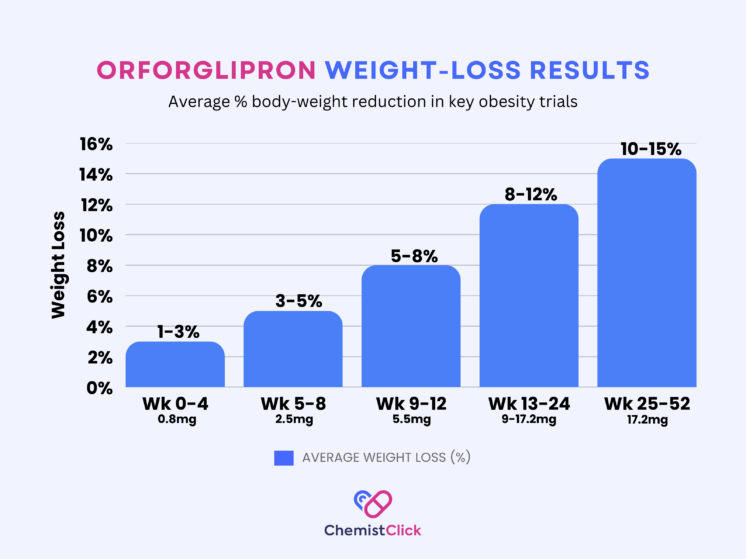
Orforglipron does not usually cause immediate weight loss. Results tend to build gradually as treatment continues and the dose is increased.
The published trial data does not provide exact average weight loss figures for every individual month.
The strongest published results are measured at 26 weeks, 36 weeks and 72 weeks. For this reason, the timeline below should be used as a practical guide rather than a guaranteed prediction.
| Time on orforglipron | Expected weight loss | What the evidence suggests |
|---|---|---|
| 1 month | Around 0% to 2% | Weight loss is usually early and modest. Appetite changes may be noticed before major weight loss. |
| 2 months | Around 1% to 4% | Some people may start to see more noticeable changes, but treatment is still in the early dose-escalation phase. |
| 3 months | Around 3% to 6% | Weight loss may become clearer for some people, although the main trial results were measured later. |
| 6 months | Around 8.6% to 12.6% | Phase 2 data showed this average weight loss range at 26 weeks, depending on dose. |
| 9 months | Around 9.4% to 14.7% | Phase 2 data showed this average weight loss range at 36 weeks, depending on dose. |
| 1 year | Around 10% to 13% | There is no exact 1-year headline result, but weight loss may continue to build if treatment is continued and tolerated. |
| 72 weeks | Around 11.1% to 12.4% | Phase 3 ATTAIN-1 data showed this average weight loss range at the highest dose. |
| 2 years | Not yet established | There is not yet enough published 2-year obesity data to give a reliable average figure. |
Early monthly figures are estimates based on available trial endpoints and dose escalation. Published trial results showed 8.6% to 12.6% weight loss at 26 weeks and 9.4% to 14.7% at 36 weeks in Phase 2 data, while Phase 3 ATTAIN-1 reported around 11.1% to 12.4% at 72 weeks.
After 1 month on orforglipron, weight loss is usually expected to be modest. This is because treatment starts at a low dose to help reduce the risk of gastrointestinal side effects.
Some people may notice reduced appetite, smaller portion sizes or feeling full sooner during the first month. However, it is too early to judge the full effect of orforglipron after only 4 weeks.
After 2 months, some people may start to see more visible changes in weight and appetite. By this stage, the dose may have been increased if treatment is tolerated.
However, orforglipron should still be viewed as a long-term treatment. A modest response after 2 months does not necessarily mean the medicine will not work, especially if a higher treatment dose has not yet been reached.
After 3 months, weight loss may become clearer for some people. Appetite suppression may be more consistent, and changes in eating habits may become easier to maintain.
There is no exact 3-month average result from the main obesity trials, but clinical data shows that meaningful weight loss continues to build over the first 6 to 9 months of treatment.
Six months is a more useful point for assessing early orforglipron results.
In the Phase 2 obesity trial, average weight loss at 26 weeks ranged from 8.6% to 12.6%, depending on the dose used. Placebo weight loss was around 2.0% at the same time point.
This suggests that people who respond well to treatment may see meaningful weight loss by around 6 months.
There is not a single published 1-year headline result from the main obesity trials. However, available data shows that weight loss continued beyond 36 weeks and remained clinically meaningful at 72 weeks.
By 1 year, people who tolerate orforglipron and continue treatment may have lost a meaningful amount of weight, particularly if they have reached an effective dose and maintained changes to diet and activity.
There is not yet enough published 2-year obesity data to give a reliable average weight loss figure for orforglipron after 2 years.
The main Phase 3 ATTAIN-1 trial measured results at 72 weeks, which is around 16.5 months. Longer-term data is needed to understand weight loss maintenance and outcomes beyond this point.
Orforglipron may start affecting appetite within the first few weeks, but visible weight loss usually takes longer.
Most people should think of orforglipron as a gradual treatment rather than a quick result. The first few months are mainly about starting treatment, increasing the dose and checking tolerability. More meaningful results are usually assessed after several months.
Orforglipron results vary from person to person. Some people respond strongly to GLP-1 medicines, while others lose less weight.
Results may be affected by:
Side effects can also affect results if they make it difficult to continue treatment or reach a higher dose.
Orforglipron has also been studied as a possible maintenance treatment after people have lost weight with injectable GLP-1 or GIP/GLP-1 medicines.
In the ATTAIN-MAINTAIN trial, people who switched to orforglipron maintained more of their previous weight loss than people switched to placebo.
This suggests orforglipron may have a future role in long-term weight management, although treatment decisions should always be made by a healthcare professional.
Orforglipron is taken once daily. Missing doses regularly may reduce how well it works, especially for appetite control.
GLP-1 medicines are usually increased gradually to improve tolerability and reduce side effects. Do not rush dose increases unless advised by your prescriber.
Further reading: Orforglipron dosage guide
Eating enough protein can help preserve muscle while losing weight. This is especially important if your appetite is much lower than usual.
Greasy, rich or very large meals can make GLP-1 side effects worse, especially nausea, reflux, bloating and diarrhoea.
Reduced appetite can sometimes mean you eat and drink less without realising. Aim to drink regularly throughout the day.
Resistance training helps protect muscle mass during weight loss and can improve body composition.
The best results come when orforglipron is combined with sustainable habits. If you stop treatment and return to previous eating patterns, weight regain is possible.
Orforglipron results are promising, particularly because it is a tablet-based GLP-1 treatment.
In clinical trials, people taking the highest dose lost around 11.1% to 12.4% of their starting body weight over 72 weeks. Earlier Phase 2 data showed weight loss of 9.4% to 14.7% after 36 weeks, depending on dose.
Weight loss with orforglipron usually happens gradually. Some people may notice appetite changes within the first few weeks, but the most meaningful results are usually seen after several months.
Longer-term data is still needed to understand how well orforglipron results are maintained beyond 72 weeks.
After one month, estimated weight loss may be up to 2% of body weight, although some people may mainly notice reduced appetite rather than dramatic scale changes.
Some people may notice appetite suppression within the first few days or weeks. Visible weight loss is more likely after 8-12 weeks.
Appetite suppression may begin within the first few days, but it can become more noticeable as the dose is gradually increased.
Not necessarily. Like other weight loss medicines, results are more likely to last if treatment is combined with long-term diet and lifestyle changes. Weight regain can happen if treatment is stopped and previous eating habits return.
Wharton S, et al. Daily Oral GLP-1 Receptor Agonist Orforglipron for Adults with Obesity. New England Journal of Medicine. 2023. https://www.nejm.org/doi/full/10.1056/NEJMoa2302392
Wharton S, et al. Orforglipron, an Oral Small-Molecule GLP-1 Receptor Agonist for Obesity. New England Journal of Medicine. 2025. https://pubmed.ncbi.nlm.nih.gov/40960239/
Eli Lilly. Lilly’s oral GLP-1, orforglipron, demonstrated meaningful weight loss and cardiometabolic improvements in complete ATTAIN-1 results. 2025. https://investor.lilly.com/news-releases/news-release-details/lillys-oral-glp-1-orforglipron-demonstrated-meaningful-weight
U.S. Food and Drug Administration. FDA Approves First New Molecular Entity Under National Priority Voucher Program. 2026. https://www.fda.gov/news-events/press-announcements/fda-approves-first-new-molecular-entity-under-national-priority-voucher-program
U.S. Food and Drug Administration. FOUNDAYO (orforglipron) tablets, prescribing information. 2026. https://www.accessdata.fda.gov/drugsatfda_docs/label/2026/220934Orig1s000lbl.pdf
Aronne LJ, et al. Orforglipron for maintenance of body weight reduction: the double-blind, randomized phase 3b ATTAIN-MAINTAIN trial. Nature Medicine. 2026. https://pubmed.ncbi.nlm.nih.gov/42120723/
Whilst all of our content is written and reviewed by healthcare professionals, it is not intended to be substituted for or used as medical advice. If you have any questions or concerns about your health, please speak to your doctor.