Retatrutide could be the most powerful weight loss injection developed so far. In clinical trials, participants lost up to 28.7% of their body weight.

However, retatrutide is not yet approved for public use. It is still in late-stage clinical trials, so the exact doses and official prescribing schedule haven’t been finalised.

Even so, the clinical trial data gives us a strong indication of how retatrutide is likely to be used in practice.

Researchers have already tested a range of doses and escalation schedules, providing valuable insight into how treatment may start, increase, and be maintained.

What is the retatrutide dosage?

There is no approved retatrutide dosage yet. Retatrutide is not currently licensed by the MHRA for weight loss in the UK, so it cannot legally be prescribed or supplied as an approved weight loss treatment.

The doses discussed online are based on clinical trials only. In Phase 3 studies, retatrutide has been given as a once-weekly injection, usually starting at 2mg once weekly before increasing gradually every four weeks.

The main dose steps being studied in the Phase 3 TRIUMPH programme are:

  • 2mg once weekly
  • 4mg once weekly
  • 6mg once weekly
  • 9mg once weekly
  • 12mg once weekly

These are clinical trial doses, not approved prescribing doses. The correct dose, dose escalation schedule and safety monitoring requirements may change if retatrutide is approved in the future.

Weight Loss Treatment

Lose up to 23% of your starting weight

Check Eligibility
Rated Excellent
Trustpilot Icon

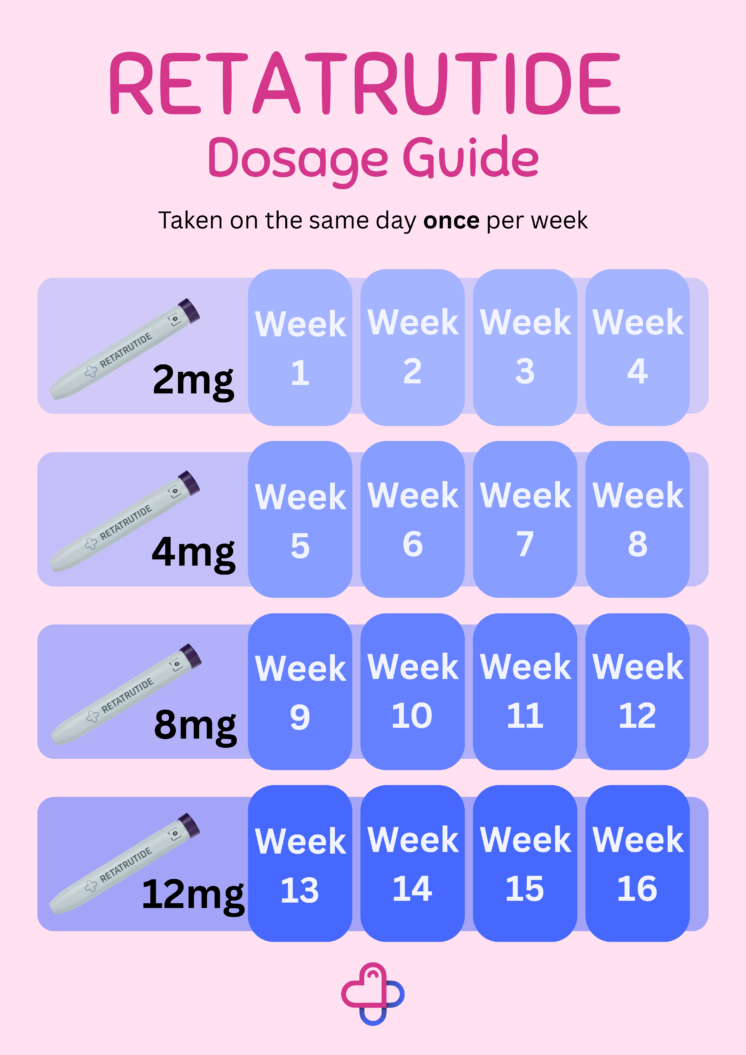
Retatrutide dosage chart

Important: this is for educational purposes only, as retatrutide is still investigational and not approved for real-world use.

Treatment Week Weekly Dose Purpose
Weeks 1-4 2mg Starting dose – allows the body to adjust and reduces early side effects
Weeks 5-8 4mg First escalation – improves appetite suppression and metabolic effects
Weeks 9-12 8mg Second escalation – associated with substantial weight loss in trials
Weeks 13+ 12mg Maximum maintenance dose studied – produced the greatest average weight loss (~28.7%)

This schedule should not be used as self-treatment guidance. Retatrutide is not approved in the UK and should only be used as part of an authorised clinical trial.

Retatrutide Dosage Chart

What is the starting dose of retatrutide?

In Phase 3 clinical trials, the starting dose of retatrutide is 2mg once weekly.

Trials have initiated treatment at a lower dose, with scheduled increases every four weeks to allow for monitoring of tolerability and side effects.

Participants then increase their dose gradually, usually every four weeks, until they reach the target dose being studied. Depending on the trial, the target dose may be 4mg, 9mg or 12mg once weekly.

There is currently no approved starting dose for patients because retatrutide has not yet been licensed for routine prescribing.

What is the maximum dose of retatrutide?

The maximum retatrutide dose currently being studied in major Phase 3 obesity trials is 12mg once weekly.

In TRIUMPH-1, retatrutide was studied at target doses of 4mg, 9mg and 12mg once weekly. The 12mg dose produced the greatest average weight loss in the trial, but it was also associated with higher rates of gastrointestinal side effects.

The maximum approved dose may be different if retatrutide is licensed in the future. Until official regulatory approval is granted, there is no approved maximum dose for clinical use.

Retatrutide maintenance dose

There is no official maintenance dose for retatrutide yet because it is still being studied and has not been approved.

In clinical trials, patients started on a lower dose and gradually increased their dose over time. Once they reached their target dose, they stayed on that dose as their maintenance dose.

In Phase 2 trials, maintenance doses included 4mg, 8mg and 12mg once weekly. Higher maintenance doses were generally linked with greater weight loss, especially when patients stayed on treatment for longer.

By 48 weeks, significant average weight loss was seen at all maintenance doses:

  • 4mg: average weight loss of 17.1% of body weight
  • 8mg: average weight loss of 22.8% of body weight
  • 12mg: average weight loss of 24.2% of body weight

With longer treatment lasting up to 68 weeks, weight loss continued, particularly at higher doses:

  • 4mg: continued weight loss, approximately 18% of body weight
  • 8mg: continued weight loss, approximately 25% of body weight
  • 12mg: average weight loss of up to 28.7% of body weight

This longer-term data shows that weight loss with retatrutide can continue beyond one year, rather than plateauing early, especially at higher maintenance doses.

Overall, clinical trials consistently demonstrate a dose-dependent effect, with higher maintenance doses producing greater average weight loss.

Why is retatrutide increased slowly?

Retatrutide is increased slowly in clinical trials to help the body adjust to the medicine and reduce the risk of side effects.

Medicines that act on gut hormone receptors can commonly cause digestive side effects, especially when treatment starts or when the dose is increased. These may include:

  • Nausea
  • Diarrhoea
  • Constipation
  • Vomiting
  • Reduced appetite
  • Indigestion or abdominal discomfort

A gradual increase gives researchers and clinicians time to monitor tolerability and safety before moving to a higher dose.

Further reading: Retatrutide side effects

MHRA regulatory status

Note: Retatrutide is currently still undergoing clinical trials and has not been approved for use in the UK by the Medicines and Healthcare products Regulatory Agency (MHRA). This means it is not legally authorised for prescription, sale, or supply in the UK at this time. 

Any website, clinic, or individual claiming to sell retatrutide is supplying an unlicensed and unauthorised medicine, which may be illegal and potentially unsafe. 

Further reading: Where to buy retatrutide in the UK

Bottom line

There is currently no approved retatrutide dosage in the UK. In Phase 3 clinical trials, retatrutide has been studied as a once-weekly injection, starting at 2mg once weekly and increasing gradually every four weeks.

The main Phase 3 dose steps include 2mg, 4mg, 6mg, 9mg and 12mg, with 12mg being the highest dose currently studied in major obesity trials.

Although trial results are promising, retatrutide is not yet licensed by the MHRA. It should not be bought online or used outside an authorised clinical trial.

Frequently Asked Questions

There is no usual approved retatrutide dosage because the medicine is not currently licensed in the UK. In clinical trials, retatrutide has been studied as a once-weekly injection using gradual dose escalation.

In Phase 3 clinical trials, participants started on 2mg once weekly. This is a trial starting dose, not an approved patient dose.

In clinical trials, retatrutide is taken once weekly as an injection.

A structured retatrutide dosing schedule allows gradual dose increases, which improves tolerability and helps reduce common side effects during treatment.

In Phase 3 clinical trials, retatrutide is usually increased every four weeks. Participants start on a lower dose, such as 2mg once weekly, before gradually increasing to the target dose being studied.

So far, clinical trials show that it is anywhere between 4mg-12mg.

The highest dose currently being studied in major Phase 3 obesity trials is 12mg once weekly.

No. Retatrutide is not approved in the UK, so there is no licensed 12mg dose for patients. It should only be used in authorised clinical trials.

There is no confirmed UK launch date for retatrutide. It must first complete regulatory review and receive approval before it can be prescribed or supplied.


Whilst all of our content is written and reviewed by healthcare professionals, it is not intended to be substituted for or used as medical advice. If you have any questions or concerns about your health, please speak to your doctor.

Share