Retatrutide is a new weight-loss injection currently in clinical trials. It works by targeting three key hormones involved in appetite and metabolism:
In clinical trials, it has shown up to 24–25% average weight loss at 48 weeks, with some participants approaching around 28% weight loss at longer durations, making it one of the most effective medications studied so far.
Retatrutide is still undergoing Phase 3 trials, and if approved, it is expected to become available in 2027.
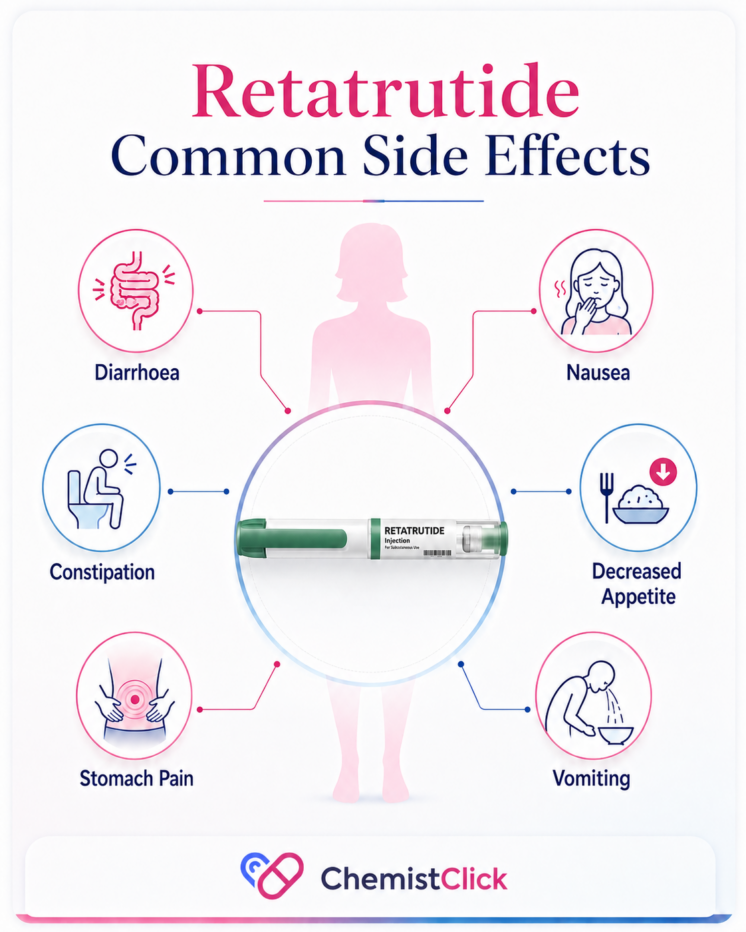
According to clinical trials so far, the most common side effects of retatrutide are related to the digestive system, such as nausea, reduced appetite, constipation, and diarrhoea.
This pattern is very similar to what we see with other GLP-1–based medications, including Mounjaro side effects, where gastrointestinal symptoms are the most frequently reported issues, particularly during the early stages of treatment while the body is adjusting.
This is the most frequently reported side effect. It usually occurs when starting treatment or increasing the dose, as the medication slows digestion and affects appetite signals. It is typically mild to moderate and improves over time.
Because retatrutide changes how quickly food moves through the gut, some people experience changes in bowel habits. These symptoms are usually temporary and settle as the body adjusts.
Some people experience vomiting, particularly during dose increases. This is usually mild and becomes less frequent once the maintenance dose is reached.
This is actually part of how the medication helps with weight loss, but some people may notice a significant drop in hunger, especially early on.
In clinical trials so far, the main heart-related effect seen with retatrutide is a small increase in resting heart rate. This effect appears to be dose-dependent and temporary.
What we know so far:
What this means in real terms:
If your resting heart rate was normally 70 bpm, it might increase to around 75–77 bpm, which is still within the normal range for most people.
This is consistent with other medications in the same class, such as GLP-1 and dual GLP-1/GIP agonists.
This is likely due to metabolic changes caused by the medication, including:
These changes can cause the heart to beat slightly faster, but this is usually mild and well tolerated.
Hair loss has not been identified as a common side effect of retatrutide in clinical trials so far.
However, some people may experience temporary hair thinning during significant weight loss, regardless of the medication used. This is usually due to a condition called telogen effluvium, where rapid weight loss, reduced calorie intake, or nutritional changes cause more hairs than usual to enter the shedding phase.
This type of hair loss is typically temporary and reversible, and hair growth often returns to normal once weight stabilises and the body adjusts.
Because retatrutide is still in clinical trials, its full long-term side effect profile is still being studied. Based on similar medications like Mounjaro, hair loss is more likely related to rapid weight loss rather than a direct effect of the medication itself.
Further reading: Mounjaro Hair Loss: Causes and Prevention
There are a few serious but rare side effects that have been observed in clinical trials so far.
In the Phase 2 trials, serious side effects appear to be rare, affecting less than 2% of participants.
Retatrutide is still in Phase 3 clinical trials, so true long-term side effects (over many years) are not yet fully known. However, based on trials lasting up to 48–72 weeks, and what we know from similar GLP1 medication, here is the most accurate clinical summary:
Potential long-term concern: cardiovascular strain in high-risk patients is theoretical, not proven.
Estimated incidence: ~0.5–1% so far
This is a class effect seen with all major weight-loss drugs.
Significant weight loss includes both:
Estimated composition of weight lost:
This can affect:
Resistance training and adequate protein intake reduce this risk.
Usually mild, but long-term symptoms may include:
These typically improve over time.
Because retatrutide activates three hormone pathways (GLP-1, GIP, glucagon), long-term monitoring is ongoing for:
No major long-term safety signal has emerged so far.
When considering retatrutide, the most important thing to keep in mind is that it is still an investigational medication.
This means it is currently only available to people participating in official clinical trials and cannot be bought at a local pharmacy yet.
Because it is a “triple-action” drug, it is more potent than current options, and doctors are paying close attention to a few specific areas:
Overall, retatrutide appears to be well tolerated, with most side effects being mild to moderate and like existing weight-loss medications such as Mounjaro and Wegovy. The most common side effects are digestive, such as nausea, constipation, diarrhoea, and reduced appetite, particularly during the early stages of treatment while the body adjusts.
More serious side effects have been rare in clinical trials. Gallbladder issues have been reported in around 0.5–1% of patients, and pancreatitis in approximately 0.3%. A small increase in resting heart rate, typically around 5–10 beats per minute, is common, but clinically significant heart problems have been uncommon. Importantly, there have been no confirmed cases of severe liver injury linked to retatrutide so far.
As retatrutide is still being studied, ongoing trials will provide more long-term safety data. However, based on current evidence, its safety profile is reassuring and broadly consistent with other medications in the same class, with serious complications remaining uncommon.
From what clinical trials show so far, most side effects are temporary, typically peaking during the first few days after a dose increase and largely resolving within 8 to 12 weeks as the body adjusts to the medication.
Yes, but they are uncommon and usually mild.
Injection-site reactions (redness, itching, swelling) affects between 1-3% of user and mild rashes occur in 1-3% of users.
Yes, but as part of its intended mechanism.
Retatrutide activates GLP-1, GIP, and glucagon, which regulate appetite, insulin, and metabolism.
Observed hormonal effects include improved insulin sensitivity, reduced hunger hormones and possible improvement in testosterone (men) and ovulatory function (women with obesity)
There is no evidence of harmful thyroid, adrenal, or reproductive hormone suppression in clinical trials to date.
Yes, but only in a small number of users. It has been reported in 2-6% of users.
Yes, a sustained increase of around 5–10 beats per minute has been observed.
This persists during treatment, and heart rate returns back to normal once treatment has been stopped.
There is no evidence so far that this heart rate increase leads to heart damage or dangerous arrhythmias in healthy individuals, but monitoring may be recommended in patients with existing cardiovascular disease.
Around 0.5–1% of patients developed gallbladder-related issues in trials. This is largely due to rapid weight loss rather than direct toxicity.
Pancreatitis has been reported rarely, at approximately 0.3% of patients in trials. It remains an uncommon but serious potential risk.
So far, no confirmed cases of severe drug-induced liver injury have been reported. Mild liver enzyme changes can occur but are uncommon and usually temporary.
Yes, some lean mass is lost during weight reduction. Approximately 15–25% of total weight lost may be lean tissue, with 75–85% being fat loss. Resistance training and adequate protein intake can reduce this.
Whilst all of our content is written and reviewed by healthcare professionals, it is not intended to be substituted for or used as medical advice. If you have any questions or concerns about your health, please speak to your doctor.