Retatrutide could be the most powerful weight loss injection developed so far. In clinical trials, participants lost up to 28.7% of their body weight.

However, retatrutide is not yet approved for public use. It is still in late-stage clinical trials, so the exact doses and official prescribing schedule haven’t been finalised.

Even so, the clinical trial data gives us a strong indication of how retatrutide is likely to be used in practice.

Researchers have already tested a range of doses and escalation schedules, providing valuable insight into how treatment may start, increase, and be maintained.

Weight Loss Treatment

Lose up to 23% of your starting weight

Check Eligibility
Rated Excellent
Trustpilot Icon

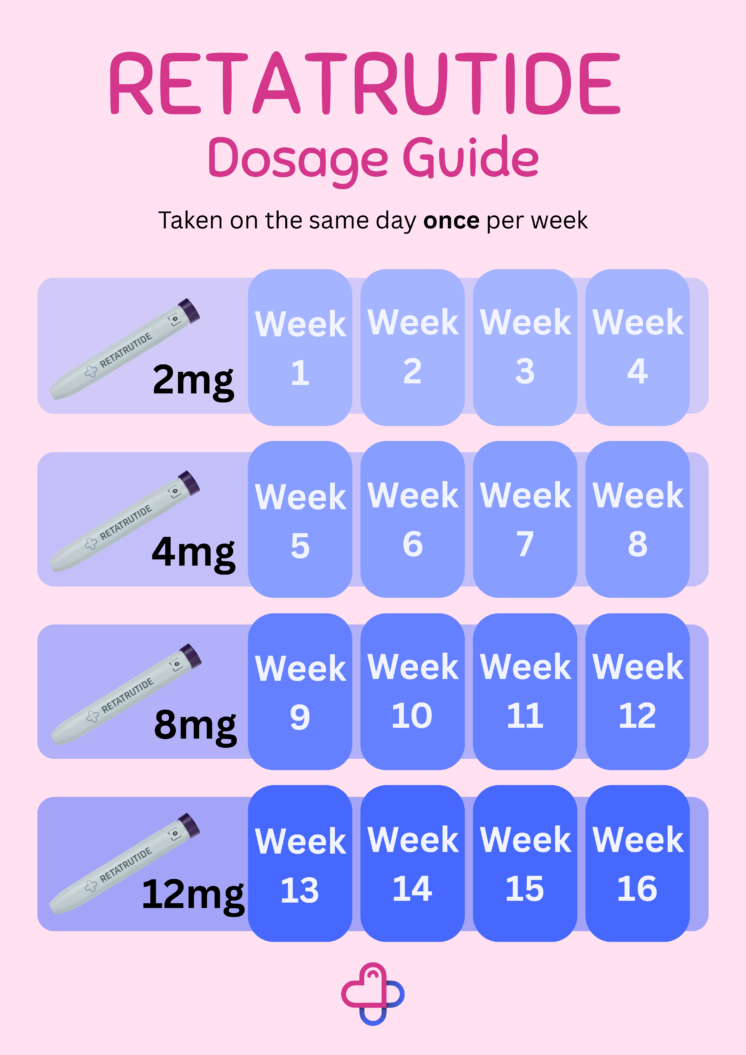
Retatrutide dosage chart

Important: this is for educational purposes only, as retatrutide is still investigational and not approved for real-world use.

Treatment Week Weekly Dose Purpose
Weeks 1–4 2mg Starting dose – allows the body to adjust and reduces early side effects
Weeks 5–8 4mg First escalation – improves appetite suppression and metabolic effects
Weeks 9–12 8mg Second escalation – associated with substantial weight loss in trials
Weeks 13+ 12mg Maximum maintenance dose studied – produced the greatest average weight loss (~28.7%)
Retatrutide Dosage Chart

What is the starting dose of retatrutide?

In clinical trials, retatrutide was usually started at a dose of 2mg once per week.

This starting dose wasn’t intended to produce the maximum weight loss straight away, but to help the body adjust and reduce the risk of side effects.

Further reading: Retatrutide side effects

In the Phase 2 obesity trial, a small number of participants started directly at 4mg once weekly, rather than starting at 2mg.

Starting at 4mg was found to be slightly harder to tolerate, with more digestive side effects early on, which is why later trials moved toward using 2mg as the standard starting dose.

Because of its good tolerability and effectiveness, 2mg once weekly is now the standard starting dose being used in ongoing Phase 3 clinical trials.

Retatrutide dose increases

Retatrutide dosing in clinical trials follows a gradual increase schedule, known as titration. This allows the body to adjust to the medication while reducing the risk of side effects.

Doses are increased every four weeks.

As the dose increases, the average weight loss also increases. This dose-dependent effect is one of the key findings from retatrutide clinical trials.

However, you can still stay on a lower dose and lose weight. It is not mandatory to increase the dose

Retatrutide maintenance dose

Clinical research hasn’t established a single official maintenance dose for retatrutide, since the drug is still investigational. However, the Phase 2 trial shows how maintenance doses were handled in practice.

In clinical trials, the amount of weight people lost on retatrutide depended on the maintenance dose they reached and how long they stayed on treatment.

After gradually increasing from the starting dose, participants remained on maintenance doses of 4mg, 8mg, or 12mg once weekly, and weight loss continued to increase over time.

By 48 weeks, significant average weight loss was seen at all maintenance doses:

  • 4mg: average weight loss of 17.1% of body weight
  • 8mg: average weight loss of 22.8% of body weight
  • 12mg: average weight loss of 24.2% of body weight

In longer-term treatment lasting up to 68 weeks, weight loss continued, particularly at higher doses:

  • 12mg: average weight loss of up to 28.7% of body weight
  • 8mg: continued substantial weight loss, typically reaching around 22–25%
  • 4mg: sustained weight loss of approximately 15–18%

This longer-term data shows that weight loss with retatrutide does not stop at one year, and can continue to improve over time, especially at higher maintenance doses.

Overall, clinical trials show that retatrutide produces better results with higher doses.

Important things to consider

Because retatrutide is still being studied, expectations, access, and long-term use are still evolving as more research is completed.

Administration

In clinical trials to date, retatrutide has been given as a once-weekly subcutaneous injection (an injection just under the skin).

Dosing is introduced slowly and the gradual build-up is an important part of how the drug is tested, rather than jumping straight to higher doses.

Availability

Retatrutide is still in Phase 3 clinical trials and has not yet been approved by the UK’s Medicines and Healthcare products Regulatory Agency (MHRA).

These large-scale trials are expected to complete in 2026, which is the key step before any company can submit a marketing authorisation application.

This means the earliest realistic availability in the UK is likely to be in late 2026 or 2027.

Note: Retatrutide is currently still undergoing clinical trials and has not been approved for use in the UK by the Medicines and Healthcare products Regulatory Agency (MHRA). This means it is not legally authorised for prescription, sale, or supply in the UK at this time. 

Any website, clinic, or individual claiming to sell retatrutide is supplying an unlicensed and unauthorised medicine, which may be illegal and potentially unsafe. 

Bottom line

Clinical trials show that retatrutide dosing follows a gradual increase from a low starting dose to a long-term maintenance dose, allowing the body to adjust while maximising weight loss.

Higher maintenance doses have consistently produced greater results, with average weight loss reaching up to 28.7% at the highest dose studied.

Frequently Asked Questions

In obesity trials to date, the retatrutide starting dose was typically 2mg once weekly, used to help the body adjust and reduce side effects before dose increases.

12mg

There is no approved retatrutide dosage yet because the medication is still investigational. Trial doses ranged from 2mg to 12mg weekly under medical supervision.

A structured retatrutide dosing schedule allows gradual dose increases, which improves tolerability and helps reduce common side effects during treatment.

So far, clinical trials show that it is anywhere between 4mg-12mg.

Because retatrutide is not yet approved, dosing should only occur within clinical trials. There is currently no real-world recommended retatrutide dosage.


Whilst all of our content is written and reviewed by healthcare professionals, it is not intended to be substituted for or used as medical advice. If you have any questions or concerns about your health, please speak to your doctor.

Share