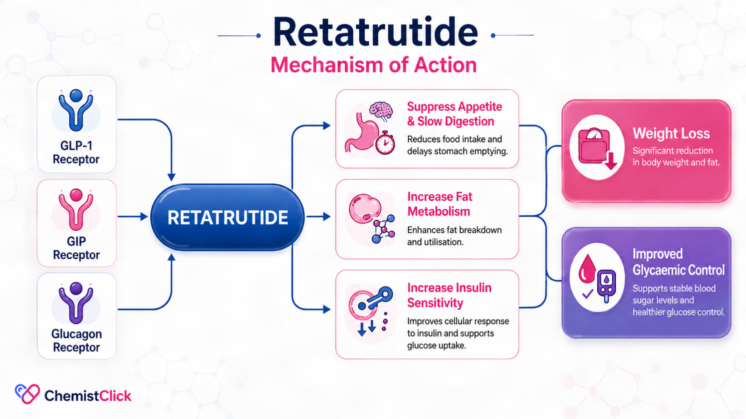
Retatrutide does four main things in the body:
| What retatrutide does |
What this means |
| Reduces appetite |
You may feel less hungry and find it easier to eat less. |
| Increases fullness |
You may feel satisfied after smaller meals. |
| Supports blood sugar control |
It may help the body release insulin when blood sugar is high. |
| Influences energy use |
It may affect how the body uses stored energy and fat. |
These effects may explain why retatrutide has produced substantial weight loss in clinical trials. However, it is still being studied and is not currently approved for routine medical use.
Why is retatrutide called a triple agonist?
Retatrutide is called a triple agonist because it activates three hormone receptors: GLP-1, GIP and glucagon.
An agonist is a substance that activates a receptor in the body. Retatrutide is designed to activate these three receptors in a way that affects appetite, fullness, glucose control and metabolism.
This triple action is the main difference between retatrutide and many existing weight loss medicines.
The 3 hormones retatrutide mimics
| Hormone pathway |
Main role |
How it may contribute |
| GLP-1 |
Appetite, fullness, digestion and insulin release |
Helps reduce hunger, slows digestion and supports blood sugar control. |
| GIP |
Insulin response and nutrient handling |
May support insulin release and work alongside GLP-1 pathways. |
| Glucagon |
Energy regulation and fat metabolism |
May increase energy use and influence how stored fat is used. |
GLP-1: appetite and fullness
GLP-1 is one of the main hormone pathways involved in appetite control.
By activating GLP-1 receptors, retatrutide may help reduce hunger and increase feelings of fullness after eating. It may also slow how quickly food leaves the stomach, which can help people feel satisfied for longer.
GLP-1 activity also helps the pancreas release insulin when blood sugar is high. This is one reason medicines acting on GLP-1 pathways can affect both weight and blood sugar.
GIP: insulin response and metabolism
GIP stands for glucose-dependent insulinotropic polypeptide.
GIP is released after eating and helps the body respond to nutrients. It can support insulin release when blood sugar levels are raised.
In retatrutide, GIP activity may work alongside GLP-1 activity to improve metabolic control. This may help explain why retatrutide is being studied for both obesity and type 2 diabetes.
Glucagon: energy use and fat metabolism
Glucagon is a hormone involved in energy balance.
Unlike GLP-1 and GIP, glucagon has a stronger role in how the body uses stored energy. By activating glucagon receptors, retatrutide may increase energy expenditure and influence fat metabolism.
This does not mean retatrutide is simply a “fat burner”. Its effects are more complex. The glucagon pathway is one part of a wider mechanism involving appetite, fullness, insulin response and energy balance.