Retatrutide is a new once-weekly injection being studied for obesity and type 2 diabetes.

It works on three hormone pathways at the same time; GLP-1, GIP and glucagon, which is why it is sometimes described as a triple agonist. It is also known as a GLP-3, or “triple-G”.

Retatrutide is still investigational, which means it has not yet been approved for routine prescribing.

What has made retatrutide so exciting is the results seen so far. In clinical trials, it has shown the potential to help people lose a substantial amount of weight, while also improving blood sugar levels in type 2 diabetics.

Weight Loss Treatment

Lose up to 23% of your starting weight

Check Eligibility
Rated Excellent
Trustpilot Icon

Retatrutide results for weight loss

Phase 2 obesity trial results

The first major retatrutide obesity study was a Phase 2 trial in adults with obesity, or overweight with a weight-related condition.

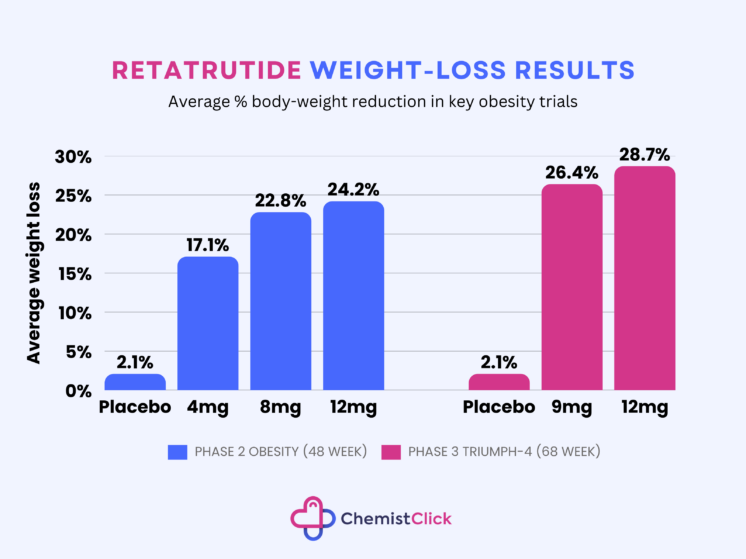
At 48 weeks, average weight loss was:

  • 17.1% with 4mg
  • 22.8% with 8mg
  • 24.2% with 12mg
  • compared with 2.1% with placebo.

These results show that many people on the higher doses lost around one-fifth to nearly one-quarter of their starting body weight in less than a year. The results were strong enough to make retatrutide stand out very early in development.

The response rates were also impressive. By week 48, 83% of people taking 12mg had lost at least 15% of their starting body weight, compared with 2% on placebo.

Longer Phase 3 weight-loss results

The newer longer weight-loss data come from TRIUMPH-4, a 68-week Phase 3 trial in adults with obesity or overweight plus knee osteoarthritis.

In TRIUMPH-4, average weight loss at 68 weeks reached:

  • 26.4% with 9mg
  • 28.7% with 12mg
  • compared with 2.1% with placebo.

In the 12mg group, 58.6% of participants lost at least 25% of their body weight, and 39.4% lost at least 30%.

These results suggest that retatrutide may help some people lose more than a quarter of their starting weight over the course of treatment.

One important point is that TRIUMPH-4 included people with knee osteoarthritis, so it is not exactly the same as a broad general-obesity study.

Even so, it provides the strongest longer Phase 3 weight-loss signal available so far.

Retatrutide results for weight loss

Retatrutide results for type 2 diabetes

Phase 2 diabetes trial results

Retatrutide has also shown promising results in type 2 diabetes.

In the published Phase 2 diabetes trial, it improved HbA1c, which is the blood test that reflects average blood sugar over the previous 2 to 3 months, and it also led to meaningful weight loss.

At 24 weeks, HbA1c fell by:

  • 1.39% in one 4mg group
  • 1.30% in another 4mg group
  • 1.99% in one 8mg group
  • 1.88% in another 8mg group
  • 2.02% in the 12mg group
  • compared with 0.01% with placebo.
Retatrutide diabetes results

At 36 weeks, body weight fell by:

  • 7.92% in one 4mg group
  • 10.37% in another 4mg group
  • 16.81% in the 8mg slow-escalation group
  • 16.34% in the 8mg fast-escalation group
  • 16.94% in the 12mg group
  • compared with 3.0% with placebo and 2.02% with dulaglutide 1.5 mg.

For patients, the key message is straightforward: in Phase 2, retatrutide appeared to help with both blood sugar control and weight loss at the same time.

That is especially relevant because many people with type 2 diabetes are trying to improve both.

Newer Phase 3 diabetes results: TRANSCEND-T2D-1

The most important newer diabetes study is TRANSCEND-T2D-1, the first successful Phase 3 retatrutide trial in type 2 diabetes. It was a 40-week, randomised, double-blind, placebo-controlled study in 537 adults whose diabetes was not well controlled with diet and exercise alone. Participants received 4mg, 9mg, 12mg, or placebo.

According to Lilly’s March 19 2026 readout, retatrutide lowered HbA1c by 1.7% to 2.0% across the dose groups at 40 weeks.

Reported weight loss was:

  • 11.5% with 4mg
  • 15.5% with 9mg
  • 16.8% with 12mg
  • compared with 2.5% with placebo.

Lilly also reported that people taking 12mg lost an average of 36.6 lb, and that there was no observed weight-loss plateau by week 40.

In simple terms, the newer Phase 3 diabetes study supports the same overall message as the earlier Phase 2 trial: retatrutide may offer strong blood sugar improvements together with double-digit weight loss.

It is important to note that the weight loss results seen in Phase 3 trials were not as strong as the earlier trials. This is because the Phase 3 trial was shorter, and focused on type 2 diabetics, for whom weight loss is often harder due to underlying metabolic factors.

Side effects seen in the trials

So far, the most common side effects observed are similar to other medicines in this area, especially nausea, diarrhoea and vomiting.

Side effects are more noticeable when starting the medication, or when the dose is being increased.

In the Phase 2 diabetes trial, gastrointestinal side effects were reported in 35% of people taking retatrutide, compared with 13% on placebo.

Further reading: Retatrutide side effects

What do these results mean overall?

These studies suggest retatrutide is one of the most promising obesity and diabetes treatments currently in development.

From the results so far, it appears as though retatrutide is set to beat Mounjaro in terms of weight loss potential.

Further reading: Retatrutide vs Mounjaro

The main caution is that retatrutide is still investigational. Some of the newer Phase 3 findings are currently based on official company announcements rather than full peer-reviewed journal publications, so they should be viewed as very encouraging but still not the final word.

Bottom line

Retatrutide’s trial results so far are impressive. For weight loss, the published Phase 2 obesity study showed up to 24.2% average weight loss at 48 weeks, while the longer Phase 3 trial showed up to 28.7% average weight loss at 68 weeks.

For type 2 diabetes, both the published Phase 2 study and the newer Phase 3 trial suggest retatrutide may offer a powerful combination of better blood sugar control and substantial weight loss.

Because retatrutide is not yet approved, it should not be bought from unofficial online sellers. At the moment, legitimate access is through clinical trials only.

Further reading: How to get retatrutide

Frequently Asked Questions

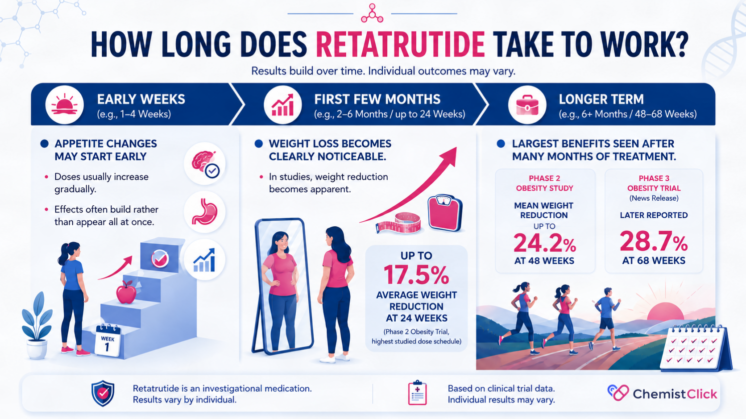
There is no official “one-month” headline result from the main retatrutide trials. The studies mainly report results at 24, 40, 48 and 68 weeks, although weight loss was already starting in the early weeks with some users experiencing 2-5% of weight loss in the first 4 weeks.

Some people may notice reduced appetite and early weight changes within the first few weeks, but the bigger results build over several months. In trials, the strongest weight-loss results were seen at 24 weeks and beyond.

Retatrutide is injected under the skin, usually into the abdomen, thigh or upper arm. There is no good evidence that one site works better than another, so the best site is the one you can use comfortably and consistently.

Use it consistently, follow the dose-escalation schedule properly, rotate injection sites, and support treatment with good nutrition, hydration and regular activity. The best results come with time and consistency, not after just a few injections.


Whilst all of our content is written and reviewed by healthcare professionals, it is not intended to be substituted for or used as medical advice. If you have any questions or concerns about your health, please speak to your doctor.

Share