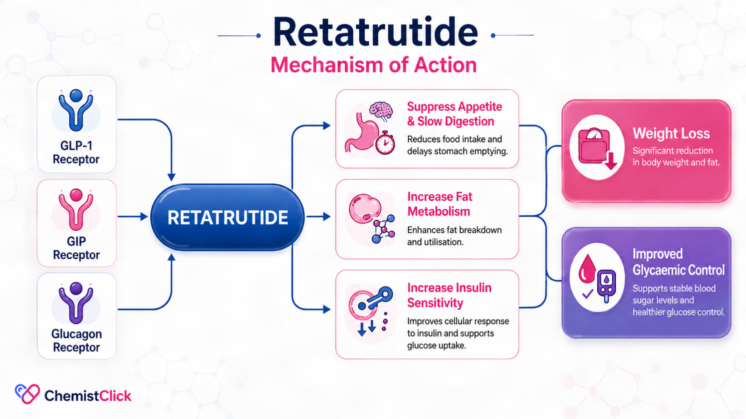
Retatrutide works by mimicking the action of three naturally occurring hormone pathways involved in appetite, digestion, blood sugar control and energy balance.
These are:
Because retatrutide activates all three receptors, it is known as a triple agonist. This means it works differently from GLP-1-only medicines and dual agonist medicines.
In simple terms, retatrutide may help reduce hunger, increase fullness after eating, support insulin release when blood sugar is high and influence how the body uses stored energy.
Retatrutide does four main things in the body:
| What retatrutide does | What this means |
|---|---|
| Reduces appetite | You may feel less hungry and find it easier to eat less. |
| Increases fullness | You may feel satisfied after smaller meals. |
| Supports blood sugar control | It may help the body release insulin when blood sugar is high. |
| Influences energy use | It may affect how the body uses stored energy and fat. |
These effects may explain why retatrutide has produced substantial weight loss in clinical trials. However, it is still being studied and is not currently approved for routine medical use.
Retatrutide is called a triple agonist because it activates three hormone receptors: GLP-1, GIP and glucagon.
An agonist is a substance that activates a receptor in the body. Retatrutide is designed to activate these three receptors in a way that affects appetite, fullness, glucose control and metabolism.
This triple action is the main difference between retatrutide and many existing weight loss medicines.
| Hormone pathway | Main role | How it may contribute |
| GLP-1 | Appetite, fullness, digestion and insulin release | Helps reduce hunger, slows digestion and supports blood sugar control. |
| GIP | Insulin response and nutrient handling | May support insulin release and work alongside GLP-1 pathways. |
| Glucagon | Energy regulation and fat metabolism | May increase energy use and influence how stored fat is used. |
GLP-1 is one of the main hormone pathways involved in appetite control.
By activating GLP-1 receptors, retatrutide may help reduce hunger and increase feelings of fullness after eating. It may also slow how quickly food leaves the stomach, which can help people feel satisfied for longer.
GLP-1 activity also helps the pancreas release insulin when blood sugar is high. This is one reason medicines acting on GLP-1 pathways can affect both weight and blood sugar.
GIP stands for glucose-dependent insulinotropic polypeptide.
GIP is released after eating and helps the body respond to nutrients. It can support insulin release when blood sugar levels are raised.
In retatrutide, GIP activity may work alongside GLP-1 activity to improve metabolic control. This may help explain why retatrutide is being studied for both obesity and type 2 diabetes.
Glucagon is a hormone involved in energy balance.
Unlike GLP-1 and GIP, glucagon has a stronger role in how the body uses stored energy. By activating glucagon receptors, retatrutide may increase energy expenditure and influence fat metabolism.
This does not mean retatrutide is simply a “fat burner”. Its effects are more complex. The glucagon pathway is one part of a wider mechanism involving appetite, fullness, insulin response and energy balance.
Retatrutide is different from many existing weight loss treatments because it is being studied as a triple agonist.
This means it acts on three hormone receptor pathways involved in appetite, fullness, blood sugar control and energy balance. Some licensed weight loss injections act on one or two of these pathways, whereas retatrutide is being studied for its effect on three.
This broader mechanism may help explain why retatrutide has shown strong results in clinical trials. However, retatrutide is still investigational and is not currently approved in the UK.
This does not mean retatrutide is better or more suitable than existing licensed treatments. The right treatment depends on a patient’s BMI, medical history, current medicines, side effect risk and clinical assessment.
Further reading: Retatrutide results
Retatrutide may help improve blood sugar regulation.
It can activate hormone pathways that support insulin release when blood sugar is high. Clinical trials have shown improvements in A1C, which is a blood test used to measure average blood sugar levels over time.
Retatrutide is being studied in people with obesity, overweight and type 2 diabetes, but it is not currently approved as a diabetes or weight loss treatment in the UK.
Retatrutide may influence energy use through its glucagon receptor activity.
This is one of the reasons it is different from GLP-1-only treatments. Glucagon is involved in energy regulation and may affect how the body uses stored fuel.
However, retatrutide should not be described as a simple metabolism booster. Its weight loss effects are likely due to several combined actions, including appetite reduction, increased fullness, glucose regulation and changes in energy balance.
Retatrutide may support fat loss as body weight decreases, but it is not simply a fat-burning injection.
Its glucagon activity may influence how stored energy is used, while its GLP-1 and GIP activity may help reduce food intake and support blood sugar control. Together, these effects may lead to weight loss and reductions in body fat.
Retatrutide does not specifically target one area of fat, such as belly fat. Fat loss usually occurs across the body over time and typically increases as the dose is increased.
Further reading: Retatrutide dosage guide
Retatrutide works by activating three hormone receptors: GLP-1, GIP and glucagon.
This triple action may reduce appetite, increase fullness, support blood sugar control and influence how the body uses energy. These combined effects may explain why retatrutide has produced significant weight loss in clinical trials.
However, retatrutide remains an investigational medicine. It is not currently approved in the UK and cannot legally be prescribed or bought as a licensed weight loss treatment.
Further reading: How to get retatrutide
Retatrutide may reduce hunger, increase fullness, support insulin release when blood sugar is high and influence how the body uses stored energy.
No medicine works exactly the same for everyone. In trials, average results were strong, but people did not all lose the same amount of weight or get the same level of glucose improvement.
That is normal in obesity and diabetes treatment, and it is one reason dose titration and medical review matter.
The dose should only be increased by a medical professional. Increasing the dose yourself can be harmful to your health and increase the chances of experiencing side effects with retatrutide.
For diabetes, retatrutide appears to help by improving the body’s hormone response to food, especially through GLP-1 and GIP, which support insulin release when glucose is high.
It may also help through weight loss, since losing weight can improve insulin resistance. In phase 2 diabetes research, retatrutide improved glycaemic control and reduced body weight, and Lilly’s phase 3 topline results reported HbA1C reductions of around 1.7% to 2.0% at 40 weeks.
Retatrutide also works on the glucagon receptor, which may help the body use more energy and break down fat more effectively. This extra action could be one reason retatrutide may lead to greater weight loss than medicines that mainly work through GLP-1 alone.
Jastreboff AM, Kaplan LM, Frias JP, et al. Triple–Hormone-Receptor Agonist Retatrutide for Obesity. New England Journal of Medicine. https://www.nejm.org/doi/full/10.1056/NEJMoa2301972
Eli Lilly and Company. Lilly’s triple agonist, retatrutide, delivered powerful weight loss in pivotal Phase 3 obesity trial. Published 21 May 2026. https://investor.lilly.com/node/54321/pdf
Eli Lilly and Company. Lilly’s triple agonist, retatrutide, drove substantial improvements in weight, A1C, knee osteoarthritis pain, and obstructive sleep apnea. Published 6 June 2026. https://investor.lilly.com/news-releases/news-release-details/lillys-triple-agonist-retatrutide-drove-substantial-improvements
Sanyal AJ, Kaplan LM, Frias JP, et al. Triple hormone receptor agonist retatrutide for metabolic dysfunction-associated steatotic liver disease: a randomized phase 2a trial. Nature Medicine. 2024. https://pubmed.ncbi.nlm.nih.gov/38858523/
Eli Lilly and Company. What to know about retatrutide. https://www.lilly.com/news/stories/what-to-know-about-retatrutide
Whilst all of our content is written and reviewed by healthcare professionals, it is not intended to be substituted for or used as medical advice. If you have any questions or concerns about your health, please speak to your doctor.