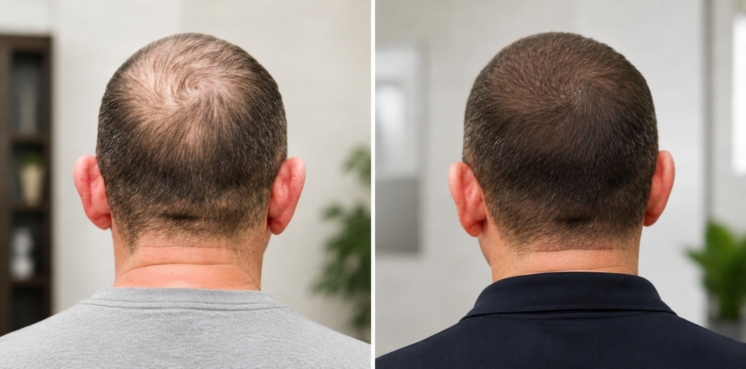
In this guide, we’ll explain what finasteride can do, what the evidence shows, and what kind of results you can realistically expect.
Finasteride works by lowering levels of a hormone called DHT (dihydrotestosterone) in the scalp. DHT is the main hormone that causes hair follicles to shrink in men with male-pattern hair loss.
By reducing DHT, finasteride helps slow down further hair loss and can allow weakened hair follicles to recover and grow thicker again.
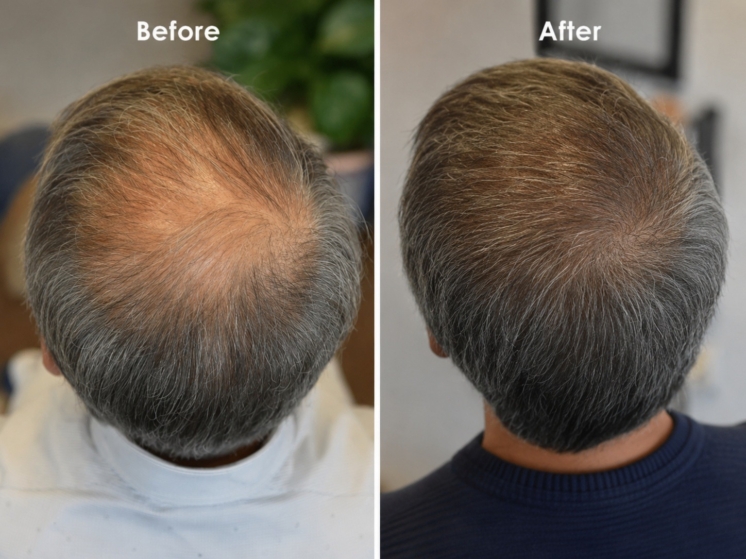
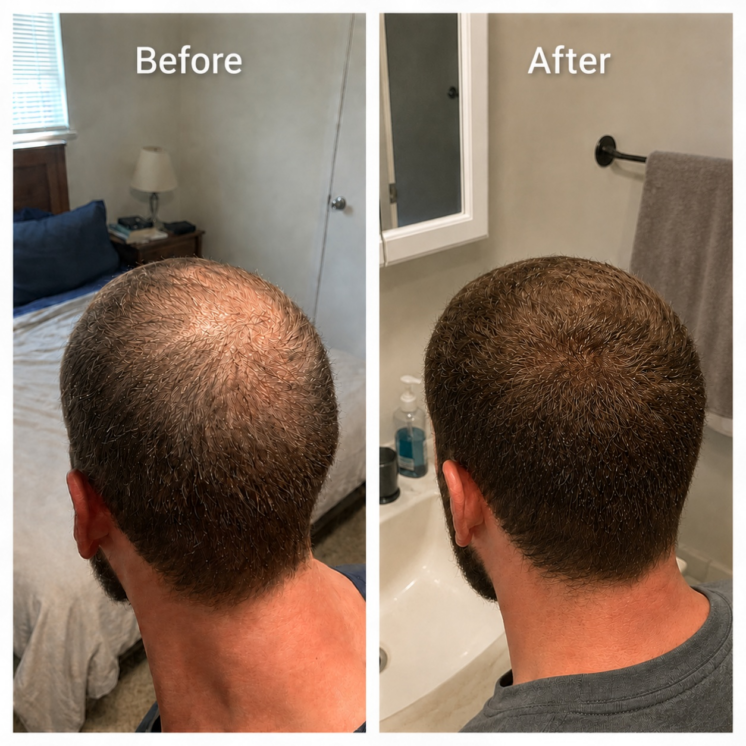
It does not create new hair follicles, but it can help protect the hair you still have and improve hair density over time, especially on the crown and mid-scalp.
If your hair follicles are dead, for example, if you are completely bald, or you have a shiny patch on your scalp, regrowth with Finasteride is highly unlikely.
Further reading: Does finasteride work?
Data from clinical trials saw many men experience hair regrowth with finasteride.
In regard to slowing further hair loss, data from clinical trials demonstrated that finasteride can slow the progression of hair loss, even if hair regrowth is limited.
| Scalp Area | Expected Regrowth with Finasteride |
|---|---|
| Crown / Vertex | ⭐⭐⭐⭐☆ (Best regrowth + stabilisation) |
| Mid-scalp | ⭐⭐⭐⭐☆ (Strong thickening + maintenance) |
| Frontal hairline | ⭐⭐☆☆☆ (Variable, mainly stabilisation) |
| Temples | ⭐⭐☆☆☆ (Less predictable regrowth) |
| Fully bald areas | ⭐☆☆☆☆ (Minimal to none) |
Bottom Line
Finasteride can regrow hair in about half to two-thirds of men over 1–2 years and prevents further hair loss in most users.
It works best on the crown and mid-scalp, takes several months to show results, and must be taken long-term to maintain benefits. Early treatment gives the best chance of visible improvement.
Further reading: Finasteride results
Finasteride is suitable for men who are starting to notice hair loss or want to stop it getting worse.
It may be a good option if you:
Finasteride works best when hair follicles are still active, so starting earlier usually gives better results.
It may be less helpful if hair loss is advanced and areas are already completely bald, as those follicles may not grow back.
If you’re unsure whether finasteride is right for you, our team can help assess your hair loss and discuss your options.
Yes, finasteride can help regrow hair, but results vary. It works best at slowing hair loss and thickening existing hair, with some seeing noticeable regrowth, especially at the crown, after several months of daily use.
Finasteride can help regrow hair and slow down hair loss, but the results only last as long as you keep taking it. If you stop, hair loss usually starts again over time.
Finasteride mostly slows hair loss and helps keep the hair you still have. Some men see modest regrowth, often at the crown, with hair becoming thicker and fuller over 6–12 months or more.
Whilst all of our content is written and reviewed by healthcare professionals, it is not intended to be substituted for or used as medical advice. If you have any questions or concerns about your health, please speak to your doctor.
Finasteride, also known as Propecia, is a hair loss tablet for men. It is one of the few drugs that has been approved for treating male pattern hair loss, also known as Androgenetic Alopecia.
Read the article